
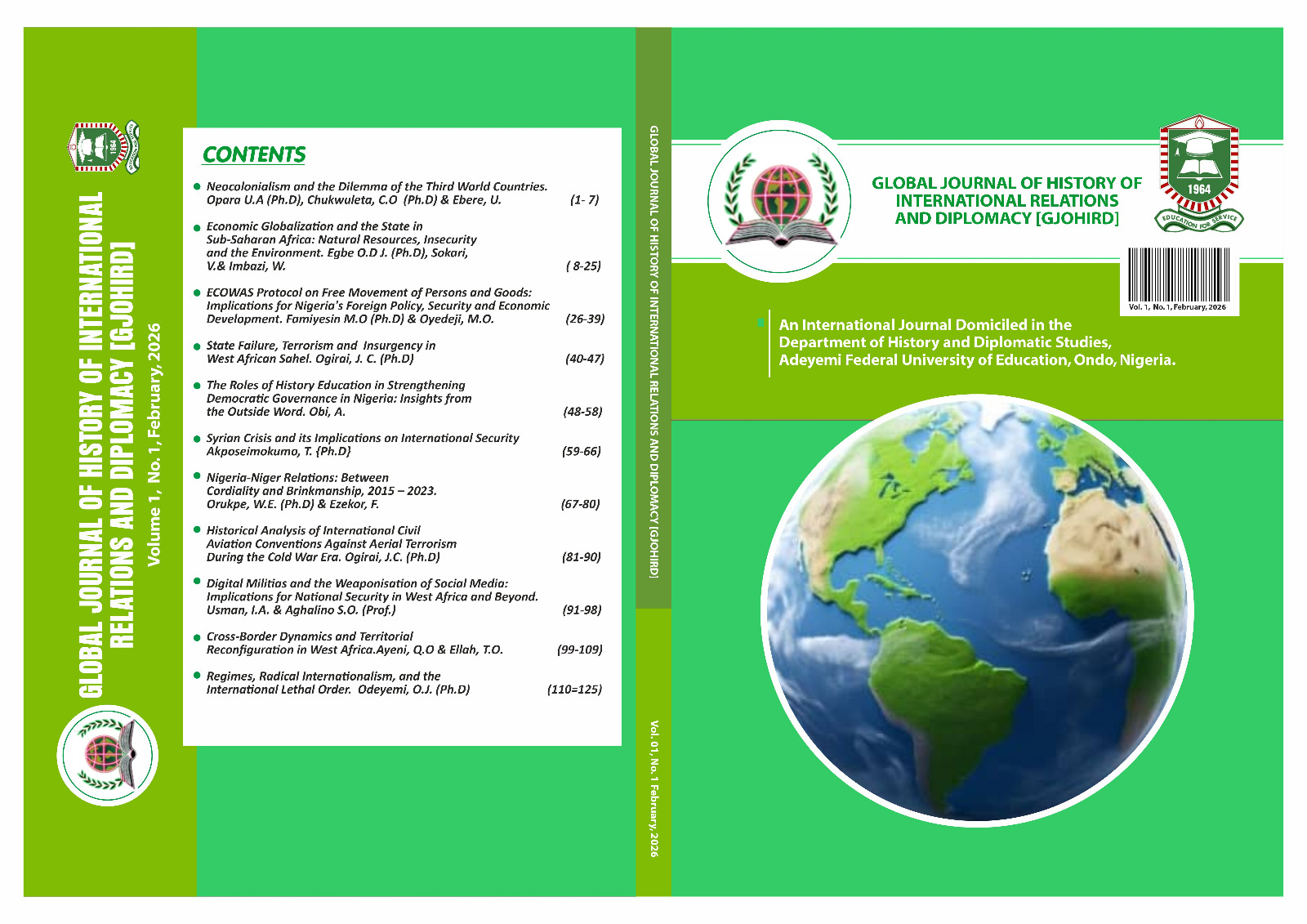
- NEOCOLONIALISM AND THE DILEMMA OF THE THIRD WORLD COUNTRIES. pp. 1-7
- ECONOMIC GLOBALIZATION AND THE STATE IN SUB-SAHARAN AFRICA NATURAL RESOURCES, INSECURITY AND THE ENVIRONMENT. pp. 8-25
- ECOWAS PROTOCOL ON FREE MOVEMENT OF PERSONS AND GOODS: IMPLICATIONS FOR NIGERIA’S FOREIGN POLICY, SECURITY AND ECONOMIC DEVELOPMENT. pp. 26-39
- STATE FAILURE, TERRORISM AND INSURGENCY IN THE WEST AFRICAN SAHEL. pp. 40-47
- THE ROLES OF HISTORY EDUCATION IN STRENGTHENING DEMOCRATIC GOVERNANCE IN NIGERIA: INSIGHTS FROM THE OUTSIDE WORLD. pp.48-58
- SYRIAN CRISIS AND ITS IMPLICATIONS ON INTERNATIONAL SECURITY. pp. 59-66
- NIGERIA-NIGER RELATIONS: BETWEEN CORDIALITY AND BRINKMANSHIP, 2015-2023. pp. 67-80
- HISTORICAL ANALYSIS OF INTERNATIONAL CIVIL AVIATION CONVENTIONS AGAINST AERIAL TERRORISM DURING THE COLD WAR ERA. pp. 81-90
- DIGITAL MILITIAS AND THE WEAPONIZATION OF SOCIAL MEDIA: IMPLICATIONS FOR NATIONAL SECURITY IN WEST AFRICA AND BEYOND. pp. 91-98
- CROSS-BORDER DYNAMICS AND TERRITORIAL RECONFIGURATION IN WEST AFRICA. pp. 99-109
- REGIMES, RADICAL INTERNATIONALISM, AND THE INTERNATIONAL LETHAL ORDER. pp. 110-125
Abstract: This study examines the complex dynamics of neocolonialism and its impact on the developmental trajectories of the third world countries. Neocolonialism, characterised by subtle and insidious form of external control and influence poses significant challenges to the sovereignty, economic development and self-determination of these nations. Through a critical analysis of historical and contemporary contexts, this research explored the multifaceted nature of neocolonialism, its manifestations and its implications for third world countries. This study argues that neocolonialism perpetuates a cycle of dependency, underdevelopment and marginalization, hindering the ability of third world countries to achieve sustainable development and self-reliance. It examined the role of various actors including multinational corporations, international financial institutions and powerful nations in perpetuating neocolonialism. The research also highlighted the agency and resilience of third world countries, exploring strategies for resistance self-determination and development. This study contributes to a deeper understanding of the neocolonial dynamics that shape the experiences of third world countries. Its findings and insights are poised to inform policy, debates, academic discussions, and grassroots movements aimed at promoting decolonization, self-determination, and sustainable development in the Global South.
Keywords: Neocolonialism, Dependency, Third World Countries, Under-development, Economic Development, Multinational Corporations.