
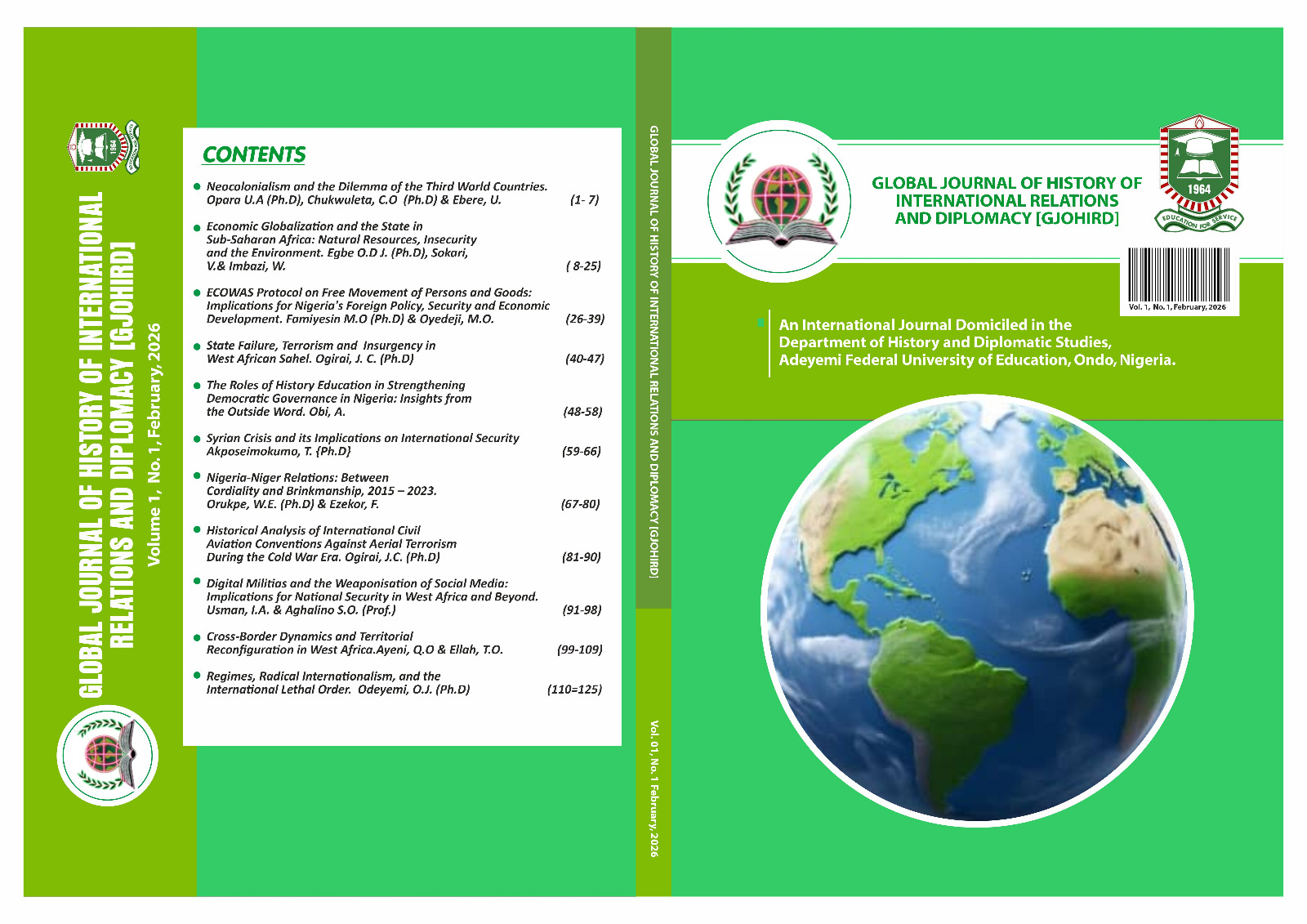
- NEOCOLONIALISM AND THE DILEMMA OF THE THIRD WORLD COUNTRIES. pp. 1-7
- ECONOMIC GLOBALIZATION AND THE STATE IN SUB-SAHARAN AFRICA NATURAL RESOURCES, INSECURITY AND THE ENVIRONMENT. pp. 8-25
- ECOWAS PROTOCOL ON FREE MOVEMENT OF PERSONS AND GOODS: IMPLICATIONS FOR NIGERIA’S FOREIGN POLICY, SECURITY AND ECONOMIC DEVELOPMENT. pp. 26-39
- STATE FAILURE, TERRORISM AND INSURGENCY IN THE WEST AFRICAN SAHEL. pp. 40-47
- THE ROLES OF HISTORY EDUCATION IN STRENGTHENING DEMOCRATIC GOVERNANCE IN NIGERIA: INSIGHTS FROM THE OUTSIDE WORLD. pp.48-58
- SYRIAN CRISIS AND ITS IMPLICATIONS ON INTERNATIONAL SECURITY. pp. 59-66
- NIGERIA-NIGER RELATIONS: BETWEEN CORDIALITY AND BRINKMANSHIP, 2015-2023. pp. 67-80
- HISTORICAL ANALYSIS OF INTERNATIONAL CIVIL AVIATION CONVENTIONS AGAINST AERIAL TERRORISM DURING THE COLD WAR ERA. pp. 81-90
- DIGITAL MILITIAS AND THE WEAPONIZATION OF SOCIAL MEDIA: IMPLICATIONS FOR NATIONAL SECURITY IN WEST AFRICA AND BEYOND. pp. 91-98
- CROSS-BORDER DYNAMICS AND TERRITORIAL RECONFIGURATION IN WEST AFRICA. pp. 99-109
- REGIMES, RADICAL INTERNATIONALISM, AND THE INTERNATIONAL LETHAL ORDER. pp. 110-125
Abstract: Nigeria and Niger Republic are two West African neighbours with geostrategic interests. Nigeria’s fraternal relationship with Niger Republic draws its breath of life from more than just her Afrocentrism. It is rooted in their histories. The peoples of both countries were hitherto territorially yoked before European scramble for African territory unbundled them in 1884/1885. Yet, cordiality between Northern Nigerians and Nigeriens survived colonial sundering and deepened in the post-colonial period. Blood ties between the Hausa, Kanuri and Fulani people in Nigeria and Niger plus their historical socio-economic contact took Nigeria-Niger cordial relations to new heights. Hence, Nigeria under President Muhammadu Buhari arguably drew closer to Niger due to his Fulani roots. But in 2023, under President Bola Tinubu Nigeria Niger relations deteriorated to knife-edge brinkmanship partly due to leadership personality and perception changes. This paper interrogated how this development challenged Nigeria’s Afrocentrism and open new remedial foreign policy options. Using the historical research methodology and the constructivist analytical framework, this study chronicled the changing nature of Nigeria-Niger relations. It found that cordiality in Nigeria and Niger relations was anchored on their response and adaptation to internal and external factors. Cordiality peaked in 1985 when Buhari as serving Nigerian Head-of-State defied international relations common sense. He voted for a Nigerien as OAU Secretary-General instead of his Nigerian opponent. It continued in 2023 when Buhari government constructed a railway line to Niger Republic and partly funded its government. Brinkmanship later set in when Niger’s military coup threatened Western democratic and economic interests and infringed upon ECOWAS Protocol. At the brink of war, this paper conclude that Nigeria-Niger historic socio-cultural ties and Nigeria’s Afrocentrism prevailed and cleared the path for cordiality to return.
Keywords: Nigeria, Niger Republic, Cordiality, Brinksmanship, Afrocentrism