
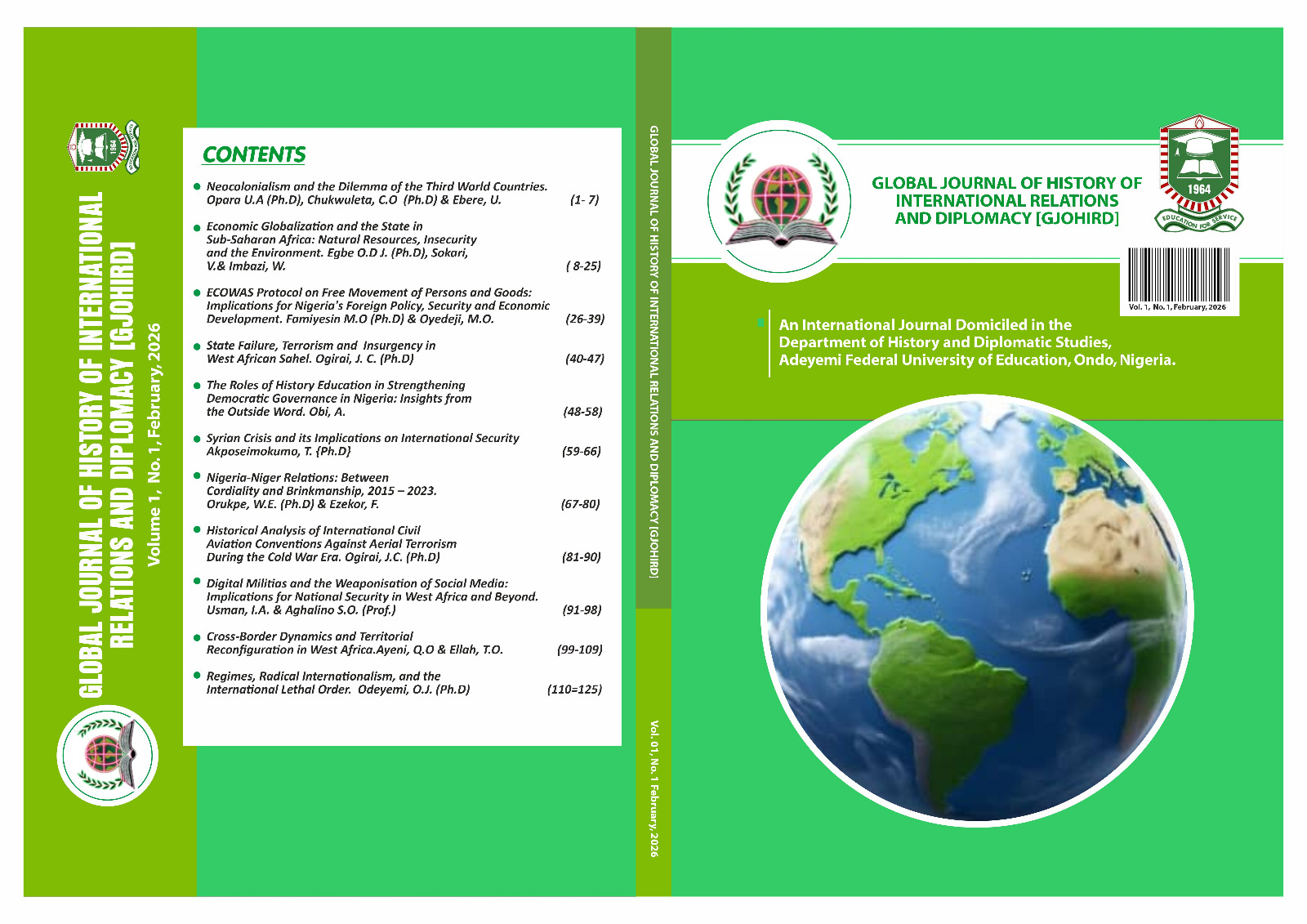
- NEOCOLONIALISM AND THE DILEMMA OF THE THIRD WORLD COUNTRIES. pp. 1-7
- ECONOMIC GLOBALIZATION AND THE STATE IN SUB-SAHARAN AFRICA NATURAL RESOURCES, INSECURITY AND THE ENVIRONMENT. pp. 8-25
- ECOWAS PROTOCOL ON FREE MOVEMENT OF PERSONS AND GOODS: IMPLICATIONS FOR NIGERIA’S FOREIGN POLICY, SECURITY AND ECONOMIC DEVELOPMENT. pp. 26-39
- STATE FAILURE, TERRORISM AND INSURGENCY IN THE WEST AFRICAN SAHEL. pp. 40-47
- THE ROLES OF HISTORY EDUCATION IN STRENGTHENING DEMOCRATIC GOVERNANCE IN NIGERIA: INSIGHTS FROM THE OUTSIDE WORLD. pp.48-58
- SYRIAN CRISIS AND ITS IMPLICATIONS ON INTERNATIONAL SECURITY. pp. 59-66
- NIGERIA-NIGER RELATIONS: BETWEEN CORDIALITY AND BRINKMANSHIP, 2015-2023. pp. 67-80
- HISTORICAL ANALYSIS OF INTERNATIONAL CIVIL AVIATION CONVENTIONS AGAINST AERIAL TERRORISM DURING THE COLD WAR ERA. pp. 81-90
- DIGITAL MILITIAS AND THE WEAPONIZATION OF SOCIAL MEDIA: IMPLICATIONS FOR NATIONAL SECURITY IN WEST AFRICA AND BEYOND. pp. 91-98
- CROSS-BORDER DYNAMICS AND TERRITORIAL RECONFIGURATION IN WEST AFRICA. pp. 99-109
- REGIMES, RADICAL INTERNATIONALISM, AND THE INTERNATIONAL LETHAL ORDER. pp. 110-125
Abstract: History education plays a pivotal role in shaping democratic governance by fostering civic awareness, critical reasoning, and historical consciousness. In Nigeria, the then erosion of history instruction in schools has coincided with persistent democratic challenges, including electoral apathy, corruption, and ethno-religious tensions. Drawing on comparative global experiences from transitional and mature democracies, this study examines the potential of history education to strengthening democratic governance in Nigeria. The study adopted a non-experimental, qualitative design, utilizing document analysis, comparative literature, and policy reviews to synthesize findings. Two theoretical frameworks underpin the analysis: Constructivist Learning Theory, emphasizing learner-centered engagement with historical knowledge, and Civic Republicanism Theory, highlighting the connection between informed citizenry and democratic sustainability. The major objective of the paper is to investigate how global practices in history education can inform Nigeria’s strategies for democratic consolidation. The study found that inquiry-based pedagogy, pluralistic curricula, critical engagement with historical memory, and institutional coherence are key drivers of civic competence and democratic resilience. Comparative evidence underscores that countries like South Africa, Chile, Finland, and Japan have successfully leveraged history education to foster civic responsibility, participatory engagement, and inclusive national identity. For Nigeria, implementing similar strategies requires curricular reforms, teacher professionalization, equity-focused interventions, assessment redesign, and multi-stakeholder partnerships to ensure effective translation of historical learning into democratic outcomes. The study contributes to knowledge by integrating comparative lessons with Nigerian policy contexts, demonstrating the strategic value of history education as a lever for democratic development. Policy recommendations provide a systemic roadmap to align history education with democratic objectives, emphasizing curriculum design, teacher capacity building, civic partnerships, and monitoring frameworks. This research advances the discourse on the intersection of education and governance, offering actionable insights for policymakers, educators, and civil society actors committed to democratic consolidation in Nigeria while drawing lessons from the outside world.
Keywords: History Education, Democratic Governance, Civic Competence, Comparative Global Experiences, Democratic Consolidation, Nigeria