
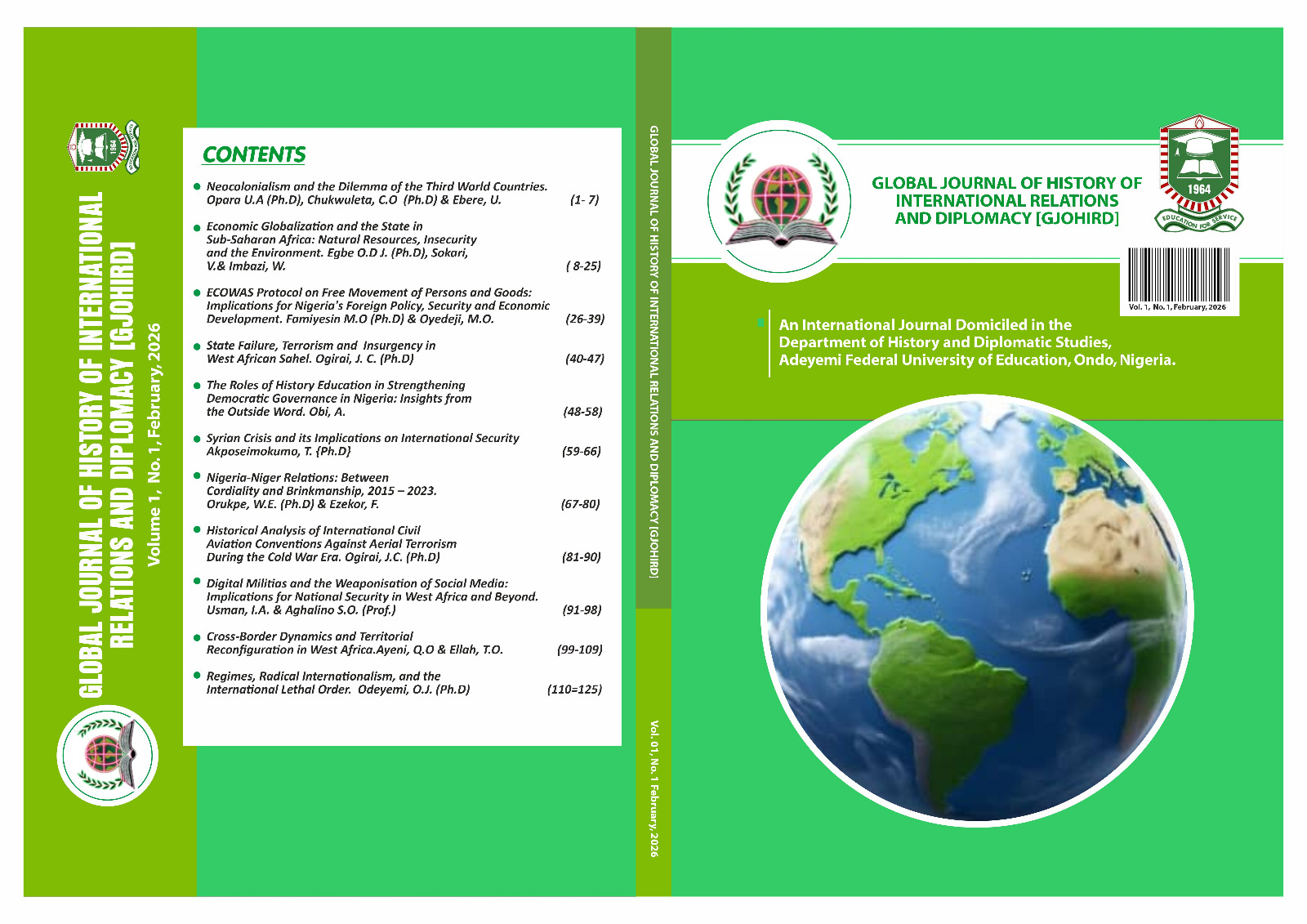
- NEOCOLONIALISM AND THE DILEMMA OF THE THIRD WORLD COUNTRIES. pp. 1-7
- ECONOMIC GLOBALIZATION AND THE STATE IN SUB-SAHARAN AFRICA NATURAL RESOURCES, INSECURITY AND THE ENVIRONMENT. pp. 8-25
- ECOWAS PROTOCOL ON FREE MOVEMENT OF PERSONS AND GOODS: IMPLICATIONS FOR NIGERIA’S FOREIGN POLICY, SECURITY AND ECONOMIC DEVELOPMENT. pp. 26-39
- STATE FAILURE, TERRORISM AND INSURGENCY IN THE WEST AFRICAN SAHEL. pp. 40-47
- THE ROLES OF HISTORY EDUCATION IN STRENGTHENING DEMOCRATIC GOVERNANCE IN NIGERIA: INSIGHTS FROM THE OUTSIDE WORLD. pp.48-58
- SYRIAN CRISIS AND ITS IMPLICATIONS ON INTERNATIONAL SECURITY. pp. 59-66
- NIGERIA-NIGER RELATIONS: BETWEEN CORDIALITY AND BRINKMANSHIP, 2015-2023. pp. 67-80
- HISTORICAL ANALYSIS OF INTERNATIONAL CIVIL AVIATION CONVENTIONS AGAINST AERIAL TERRORISM DURING THE COLD WAR ERA. pp. 81-90
- DIGITAL MILITIAS AND THE WEAPONIZATION OF SOCIAL MEDIA: IMPLICATIONS FOR NATIONAL SECURITY IN WEST AFRICA AND BEYOND. pp. 91-98
- CROSS-BORDER DYNAMICS AND TERRITORIAL RECONFIGURATION IN WEST AFRICA. pp. 99-109
- REGIMES, RADICAL INTERNATIONALISM, AND THE INTERNATIONAL LETHAL ORDER. pp. 110-125
Abstract: The interplay of cross-border dynamics and territorial reconfigurations in West Africa has become a critical area of study due to the region’s complex socio-political, economic, and cultural landscape. The problem lies in the persistent challenges posed by porous borders, weak state control, and the rise of transnational activities, including trade, migration, and security threats such as terrorism and organized crime. These dynamics often disrupt traditional territorial boundaries, creating a need for re-imagining governance structures and regional cooperation mechanisms. This research aims to investigate the multifaceted processes shaping cross-border interactions and their impact on territorial configurations in West Africa. The study examined the drivers of these dynamics, ranging from historical legacies and colonial border demarcations to globalization and regional integration efforts. The present study provides a nuanced understanding of border redefinition in reality. The rationale for this research stems from the urgent need to address the implications of these changes for state sovereignty, local livelihoods, and regional stability. It also seeks to contribute to policy discourse by identifying adaptive strategies for managing cross-border challenges. Results include a comprehensive analysis of the evolving borderland realities and actionable recommendations for fostering sustainable territorial governance in the region. The study recommends among other things that West African states should strengthen institutionalized cross-border governance frameworks, particularly through ECOWAS, in order to harmonize border management policies, promote inclusive economic cooperation, and mitigate conflicts arising from territorial reconfiguration, informal mobility, and competing local authorities across borderlands.
Keywords: Cross-border dynamics, territorial reconfiguration, West Africa, Regional integration, governance